
Trees near power lines are a common worry in Citrus County, where big oaks and pines share yards with overhead wires. Broadway Tree Care does tree trimming and pruning across the county, including clearance cuts back from roofs, driveways and the service drop to the house. Anything touching an energized line is utility work. This guide sorts out which lines are which and who to call about each.
The safe-distance rule below comes from the federal OSHA standard 29 CFR 1910.333. The utility guidance quoted here comes from the Withlacoochee River Electric Cooperative vegetation management page.
Which utility serves your address
Most of Citrus County gets its power from Duke Energy Florida. Withlacoochee River Electric Cooperative, known as WREC, serves part of the county too. Its service area covers Pasco, Hernando, Citrus, Sumter and Polk counties. Your electric bill tells you which one is yours, and that is the number to call about a tree near a line.
Three kinds of line on a typical property
The wires on poles along the road are the utility's distribution lines. The single cable that runs from the pole to your house is the service drop. Large lines on tall structures in a cleared corridor are transmission lines, which most residential lots never touch.
The utility manages trees that threaten its own lines. WREC says its vegetation crews remove trees and shrubs that could threaten power lines, and that "it is each Member's responsibility to have other trees on their property trimmed." So the tree in the middle of your yard is yours to look after, even when the wire beside it is not.
The 10-foot rule
Federal workplace safety rules set a minimum distance for anyone who is not a qualified line worker. Under OSHA's standard 1910.333, an unqualified person has to keep themselves, and the longest conductive object they could touch, at least 10 feet from an energized overhead line of 50 kilovolts or less. Higher voltages need more room. A tool with no insulating rating for that voltage counts as conductive, which takes in an aluminum ladder or an unrated pole saw.
The rule is written for workers, but the distance is a sensible line for a homeowner too. WREC's own advice is shorter: never trim, prune or remove trees near power lines yourself.
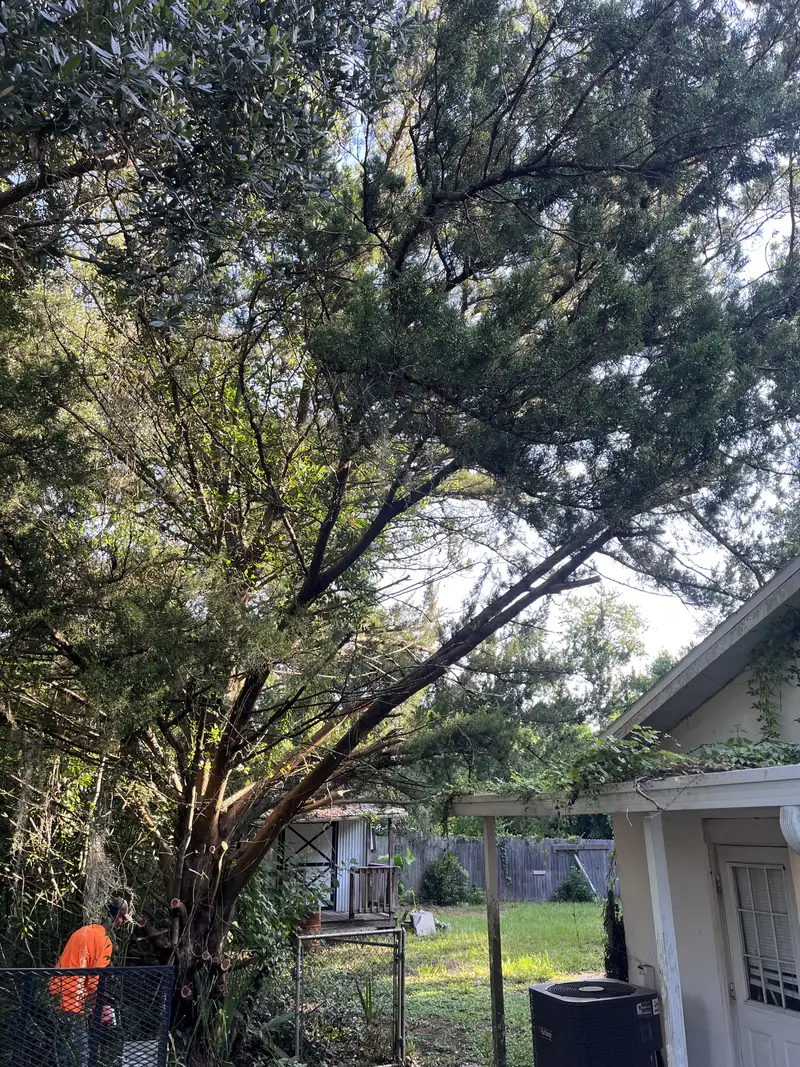
Limbs in the service drop
The service drop is where most homeowner questions start, because it runs low across the yard and trees grow up into it. A limb resting on or growing through the drop is not a do-it-yourself cut. Call your utility first and ask what it needs before any tree work near that line. WREC asks members to contact their local cooperative office before removing or trimming a tree near its lines, and Duke Energy customers should call Duke.
Once the line is dealt with, the rest of the tree is ordinary trimming. Clearance cuts away from the drop, the roof and the driveway are part of our trimming and pruning work, and we quote them on site, in writing.
After a storm
A tree or limb on a line after a storm is an emergency, not a cleanup job. Keep everyone back, and call 911 and your electric utility so they can de-energize and clear the wire. Our guide to what to do with a storm-damaged tree covers the rest of the yard.
Planting near lines
Most service-drop problems start years earlier, with a tree planted in the wrong spot. WREC recommends not planting trees and shrubs within 50 feet of its overhead lines, especially trees that grow taller than 25 feet. Before you dig, call 811. Sunshine 811 asks for a locate ticket at least two full business days ahead. Our guide to choosing where to plant a tree walks through spacing from the house, the drive and the wires.
Hernando and the rest of the county
Hernando sits along U.S. 41 on the north edge of the Tsala Apopka chain, about 5 miles north of Inverness, and we work there regularly. Our tree service page for Hernando covers trimming, removals and storm work in town. The split above holds in every Citrus County town: the line belongs to the utility, the tree belongs to you, and the 10-foot distance is the one to respect.