
Trimming a tree in Crystal River is not the same job as trimming one 15 miles inland. Broadway Tree Care does tree trimming and pruning across Citrus County, and if you searched for tree trimming Crystal River FL, that page covers the town itself: the canal lots on Kings Bay, the older neighborhoods off U.S. 19 and how we reach them. This post is about the cuts, and why salt and water change them.
The pruning guidance comes from the University of Florida: UF/IFAS Extension posts from Hillsborough, Monroe and Pinellas counties on hurricane pruning, storm recovery and saltwater flooding, and UF/IFAS research on soil salinity. The mangrove rules come from the Florida Department of Environmental Protection, and the permit rule from section 163.045 of the Florida Statutes.
What changes about trimming in Crystal River?
| Situation | What fits | Why |
|---|---|---|
| Brown, salt-burned foliage on the Gulf side of the tree | Rinse it, water the roots, wait for new growth before cutting | UF/IFAS: new growth shows which wood is actually dead. |
| Big canopy over the house, open to wind off the bay | Shorten weak limbs and balance the crown | UF/IFAS: stripping the interior raises wind damage. |
| Large tree on a wet, low lot | Lighten end weight over targets, and have the roots looked at | Shallow roots hold less than the canopy suggests. |
| Tree that sat in Helene's surge in 2024 | Remove dieback that has not come back after two growing seasons | Our reading of UF/IFAS recovery guidance. |
| Mangroves on the shoreline | Check FDEP's height rules first; October to March is best | Mangroves are regulated by the state, not by us. |
| Dead, broken or hanging limbs | Any month | They are a hazard whatever the season. |
Should you cut off salt-burned branches right away?
Usually not. After a storm, the brown side of a tree facing Kings Bay or the Gulf looks dead, and the instinct is to cut it back to green. UF/IFAS Extension in Monroe County says the better first step is getting fresh water to the roots once the salt water has gone down, then letting the plant flush with new growth and using that growth as the guide for what dieback to remove. A limb that leafs out again was not dead, and cutting it early takes away leaf area the tree needs to recover.
In Florida, salt spray, more than surge, usually does this damage. UF/IFAS research on soil salinity notes that sea spray can burn foliage directly, and that the fix for salt in the root zone is leaching it out with plenty of water or rain. Broken or hanging limbs over a roof, driveway or dock are the exception. Those come off now.
Should you thin a tree out so the wind passes through?
No, and this is the most common bad cut we see on exposed lots. UF/IFAS Extension in Hillsborough County reports that University of Florida wind tunnel experiments found that removing foliage from the interior of the crown makes wind damage more likely, not less. Stripping the inside leaves the weight and the leaves at the branch tips, which is where limbs snap.
The same source says mature trees should be pruned by shortening limbs that are weakly attached to the trunk while balancing the crown, and that topping, which often removes half or more of the leaf area, leaves the tree weaker and more prone to decay. Our hurricane-season pruning guide covers what good storm pruning looks like. We do not top trees.
Why do shallow roots change the trimming plan?
Across much of Crystal River the water table sits close to the surface, so roots spread wide and shallow instead of anchoring deep. A tree can carry a big, healthy canopy on a root plate that holds less than it looks like it should. Trimming cannot fix anchorage. What it can do is take end weight off limbs that reach over the house, the pool cage or the dock, so less of the tree is acting as a sail.
If a tree has started to lean, the soil has cracked or lifted on one side, or there are mushrooms at the base, that is no longer a trimming question. It is a tree health assessment, and the answer may be cabling or removal rather than a cut.
What about trees that sat in Hurricane Helene's surge?
Helene pushed salt water into low parts of Citrus County in September 2024. UF/IFAS Extension in Pinellas County notes that chlorides in flooded soil become more concentrated as the soil dries, that fresh rain helps, and that flooded plantings should not be fertilized right after the event. Recovery varies a lot. Some trees bounce back in a season and others decline slowly.
Two full growing seasons have now passed since Helene. Our reading is that wood on a surge-flooded tree that has still not leafed out by now is not coming back and can be pruned off, and that a tree that is thin across the whole crown, not just on one side, deserves an assessment before you trust it near the house. That is our judgment, not a UF rule.
Can you trim the mangroves on a Kings Bay lot?
Sometimes, within state limits. Mangroves are regulated under Florida's Mangrove Trimming and Preservation Act, and FDEP's homeowner guidance says a homeowner may trim mangroves in a riparian mangrove fringe (one that extends no more than 50 feet out from the shoreline) when they are no more than 10 feet tall, as long as they are not cut below 6 feet or defoliated. Mangroves taller than 10 feet need a professional mangrove trimmer, and mangroves outside a riparian fringe need a permit as well. FDEP names October through March as the best months to trim them.
Not every Crystal River shoreline has mangroves, and the rules do not cover the cabbage palms, cedars and oaks behind them. If you are not sure what is growing on your seawall, ask FDEP's Southwest District office before anyone cuts, including us.
When is the best time to trim in Crystal River?
The same University of Florida timing rules apply here as across the county: dead and broken wood any time, live-branch pruning on most shade trees in late winter before spring growth, and storm pruning done well before June. Our guide to when to trim trees in Hernando walks through that calendar in detail, and palms have their own rules in our palm trimming guide.
Do you need a permit to trim a tree in Crystal River?
It depends which side of the city line you are on. Inside city limits, the City of Crystal River sets its own tree rules and publishes a tree removal permit application through its Growth Management department (352-795-4216). Outside them, the parcel is unincorporated Citrus County, and the county's Building Division answers permit questions at 352-527-5310 or permit@citruscounty.gov. Routine pruning rarely needs a permit, but a heavy cut on a large tree is worth a call first. Our guide to tree removal permits in Citrus County covers the county's rules.
State law also applies. Under section 163.045, as amended in 2022, a local government cannot require a permit, fee or mitigation to prune, trim or remove a tree on residential property if the owner has documentation from an ISA certified arborist or a Florida licensed landscape architect that the tree poses an unacceptable risk to people or property.
What should you have ready when you call?
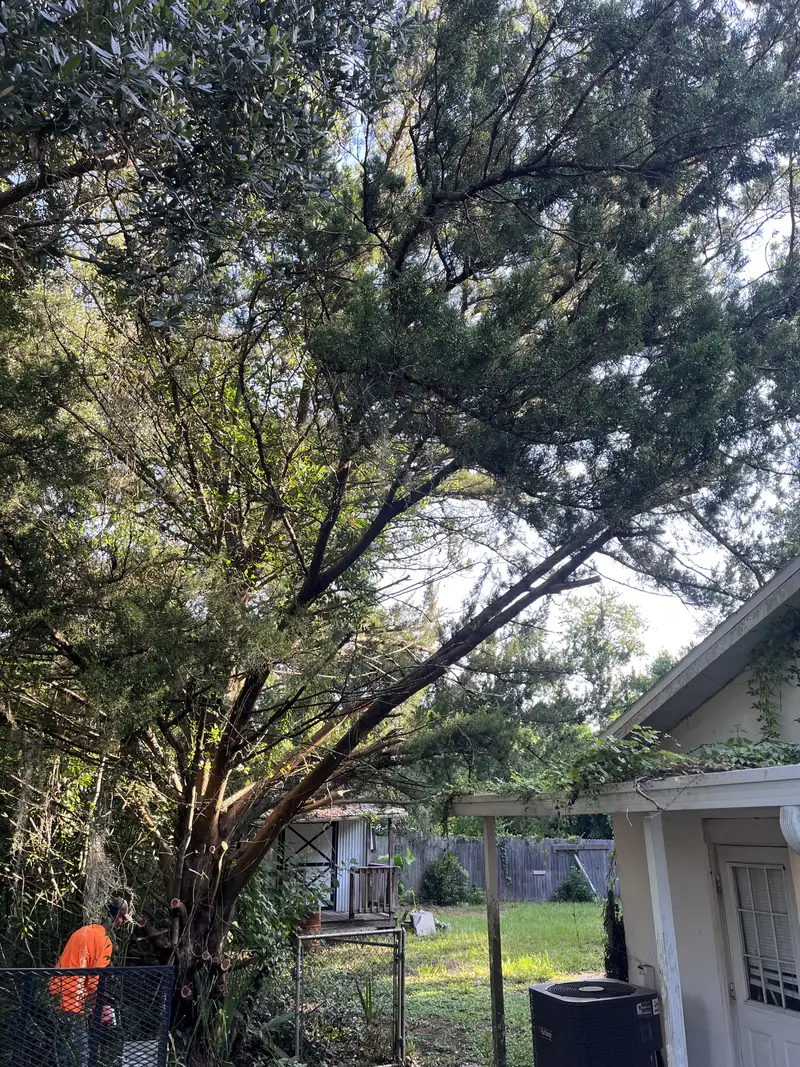
Tell us which tree or limb prompted the call, what it hangs over (a roof, a pool cage, a dock, a power drop), roughly how tall it is and whether you are inside Crystal River city limits. On canal and waterfront lots off Kings Bay, access is the whole conversation, so say how a truck reaches the tree and whether the only clear side is the water. We quote on site, in writing, before any work starts, and there is no flat rate because size, species and access set the price. We do not top trees. Cards and cash, no financing.
Sources: UF/IFAS Extension Hillsborough County, "Hurricanes and Trees – Pruning," November 1, 2018 (link); UF/IFAS Extension Monroe County, "Landscape Storm Recovery," September 30, 2022 (link); UF/IFAS Extension Pinellas County, "The Aftermath of Hurricane Helene and Soil Salinity Issues," October 2, 2024 (link); Amy L. Shober and Alexander J. Reisinger, UF/IFAS, "Tackling Soil Salinity Problems in the Home Landscape," EDIS MG447 (link); Florida Department of Environmental Protection, "Mangrove Frequently Asked Questions," last modified June 11, 2026 (link); City of Crystal River, Tree Removal Permit (link); Florida Senate, CS/SB 518 (2022), amending s. 163.045, F.S. (link). The UF/IFAS sources are guidance for Florida in general, not City of Crystal River or Citrus County rules.