
Which trees come down in a hurricane isn't random. A University of Florida IFAS team measured 18,200 trees across 100 neighborhoods after a run of hurricanes, surveyed 85 arborists and urban foresters, and turned it into lists of which species hold up and which don't. Their fact sheet, Selecting Coastal Plain Species for Wind Resistance (FOR119, revised August 2026), is where every number below comes from. Broadway Tree Care does tree removal in Homosassa, and these seven are the species on that lowest list we'd want a look at before storm season.
Homosassa runs west from U.S. 19 along both sides of the Homosassa River, out to the marshes and islands that lead into the Gulf.
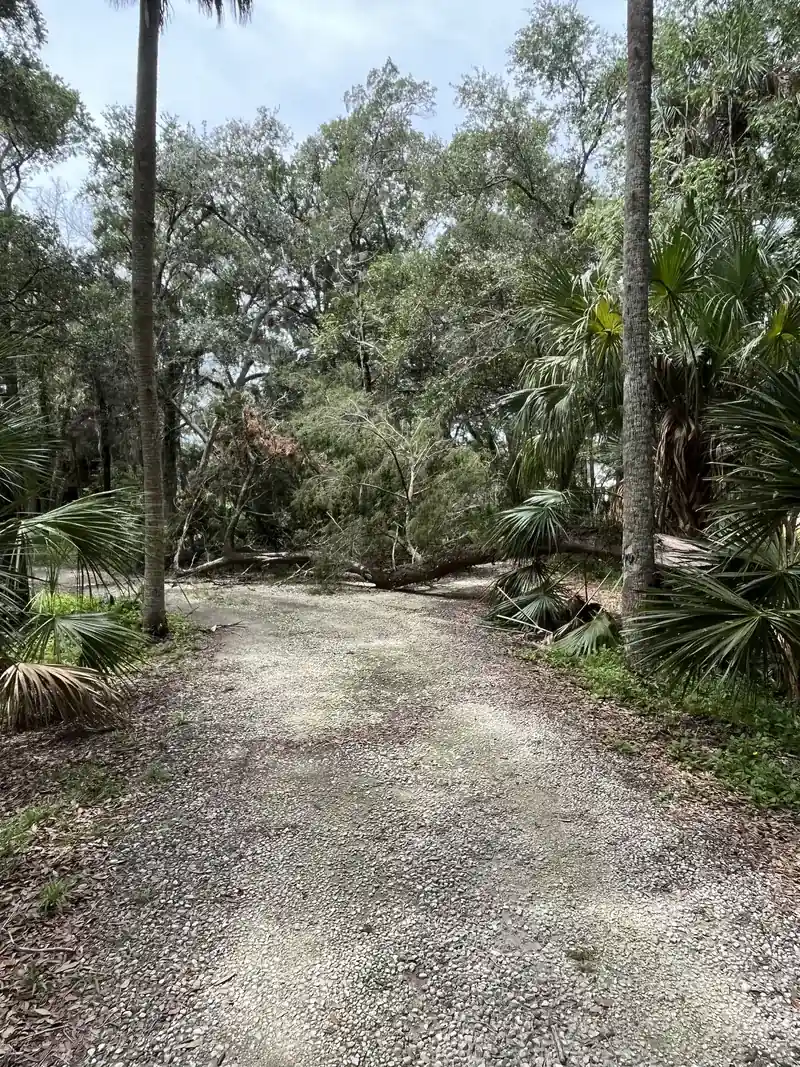
1. Laurel oak
Of the 69 experts who rated it, 57 percent called laurel oak low for wind resistance. The measurements agree. It kept 77 percent of trees standing through Hurricane Ivan, and that fell to 66 percent once trees that lost half their branches were counted as lost. Across four Panhandle hurricanes it survived significantly worse than live oak and sand live oak. We wrote more about this one in our guide to laurel oak removal.
2. Water oak
Close behind. 56 percent of 39 respondents rated it low, and Ivan left 72 percent standing, 65 percent after the branch-loss recount.
3. Sand pine
The lowest survival figure anywhere in the study's table. Sand pine kept 4 percent standing in Hurricane Jeanne and 48 percent in Ivan, and when the team came back three months after Ivan, 56 percent of the sand pines still standing had died.
4. Southern red cedar
In Ivan it lost more than a quarter of its branches on average, and survival dropped from 61 percent to 46 percent once that branch loss was counted. The authors name it alongside sand pine as a conifer with repeatedly poor hurricane performance in their studies, even though the expert survey split evenly on it.
5. Southern red oak
Most of the surveyed experts called it medium. The measurements put it at the bottom of the oaks: 60 percent standing after Ivan and 50 percent after the branch-loss recount, the lowest recalculated survival of the oaks they compared.
6. Chinese tallow
It sits on the lowest list, and the fact sheet also flags it as a prohibited invasive species in Florida. Survival ran from 97 percent in Hurricane Erin down to 73 percent in Ivan.
7. Bradford pear
58 percent of the experts who rated it called it low, the strongest low rating of any tree in the survey, and Ivan left 68 percent standing.
The other end of the list
Live oak and sabal palm are the two the fact sheet keeps coming back to. 99 percent of respondents rated sabal palm high and 89 percent did the same for live oak. Live oak held 91 to 97 percent standing in four of the six hurricanes in the study, dropping to 78 percent only at the 145 and 165 mph winds of Charley and Andrew. Baldcypress and pondcypress both drew a high rating from 91 percent of respondents, and sand live oak from 92 percent, so a yard with those already has some of the sturdiest trees on the list.
A weak species isn't an automatic removal
The authors say plainly that no species and no tree is windproof, and that soil, the tree's age and health, and how a storm moves all change the outcome. Size matters a lot. In the study, trees 39 to 79 inches across lost 30 percent of their branches on average, against 12 percent for trees under 8 inches.
So a young water oak at the edge of the yard is a different call from a big laurel oak leaning toward the house. Some of these get a structural prune instead, which is what our page on tree trimming and pruning covers, and some come down. We look at it on site and tell you which, and we'll say so when a tree is fine.
A note for waterfront lots
Florida statute 163.045 lets the owner of a single-family home remove a tree without a local permit, fee or replanting when an ISA-certified arborist or a Florida licensed landscape architect has signed an on-site assessment showing the tree is an unacceptable risk. The statute says that section doesn't apply to mangrove protection under sections 403.9321 through 403.9333, so if your lot has mangroves along the water, those rules are separate.
Getting a tree looked at in Homosassa
Call (813) 735-2777, a real person answers 24 hours a day. Tell us the species if you know it and what sits under the tree. We quote on site, in writing, before any work starts, and we take cards and cash.
Sources: UF/IFAS, Selecting Coastal Plain Species for Wind Resistance (FOR119); Florida Statutes, section 163.045; Homosassa, Florida on Wikipedia. All read October 24, 2026.