
Tree removal in Citrus Springs, FL comes with a question most of Citrus County never has to ask: whose rules apply? Citrus Springs is an unincorporated community in northern Citrus County, about 3 miles south of Dunnellon on U.S. 41, and its mail often carries a Dunnellon address. Broadway Tree Care provides tree removal across Citrus County, and Citrus Springs is in our service area. This guide covers which rules apply there and how to plan the job.
Town facts come from the Citrus Springs, Florida article on Wikipedia, and the species facts from UF/IFAS Extension. Confirm any permit question with the office named below, since rules change.
Citrus Springs is in Citrus County, not Dunnellon
Citrus Springs is a census-designated place in northern Citrus County. It had 10,246 residents at the 2020 census across about 21 square miles, and it is bordered by Pine Ridge to the south and Hernando to the east. Its ZIP codes, 34433 and 34434, are Citrus County ZIP codes that use Dunnellon as the postal city name. The City of Dunnellon itself sits just to the north, in Marion County.
Citrus Springs has no city government, so a tree there falls under unincorporated Citrus County rules. The City of Dunnellon's rules and Marion County's rules do not apply, whatever the envelope says. Under the county rule, a tree four inches or more across at four and a half feet above the ground counts as a protected tree, and removing one usually needs a county permit unless it is exempt. The Citrus County Building Division at 352-527-5310 can confirm what applies to your parcel, and our Citrus County permit guide covers the rule and its exemptions in more detail.
The exception for a dangerous tree
Florida statute 163.045 gives owners of single-family residential property a separate path. A local government cannot require a notice, permit, fee or replanting to prune, trim or remove a tree on that property if the owner has documentation that the tree poses an unacceptable risk. That documentation has to be an on-site risk assessment signed by an arborist certified through the International Society of Arboriculture or by a Florida-licensed landscape architect.
A tree crew's opinion on the phone is not that document. If you think a tree qualifies, arrange the assessment first and keep the paperwork with your records.
Laurel oaks and decay
Laurel oak is one of the common oaks in Citrus County yards, and our guide to common trees in Citrus County describes it alongside the others. The UF/IFAS Extension laurel oak fact sheet gives the species a life span of 50 to 70 years and says its trunks and large branches often hollow from decay and wood rot. It rates the tree as susceptible to breakage, and it notes that even a small trunk injury or a poor pruning cut can start a column of decay inside the trunk.
A green canopy does not rule that out. If a large laurel oak stands near the house, have it checked for decay before you decide between pruning and removal. Our list of signs a tree needs to be removed covers what to look for from the ground.
Younger laurel oaks are a different conversation. The same fact sheet says strong structure depends on training the tree early, with major branches well spaced along a single central trunk and kept under half the trunk's diameter. A young oak with that structure is usually a pruning job, not a removal.
Planning the removal
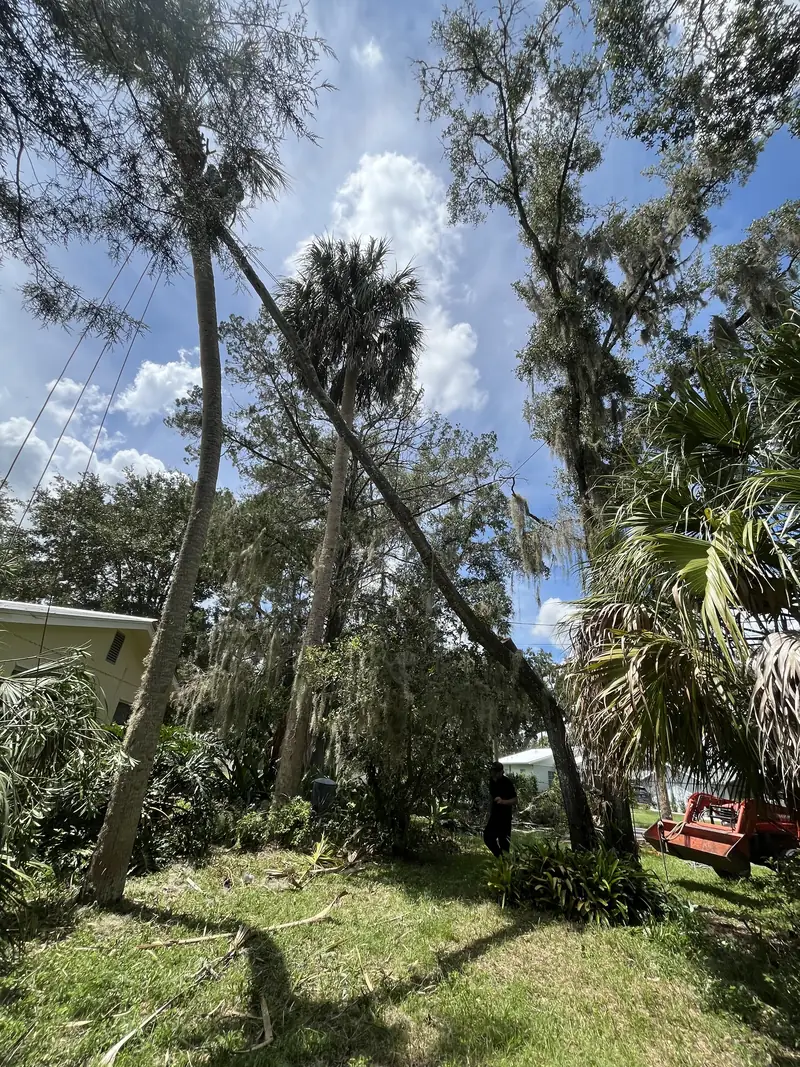
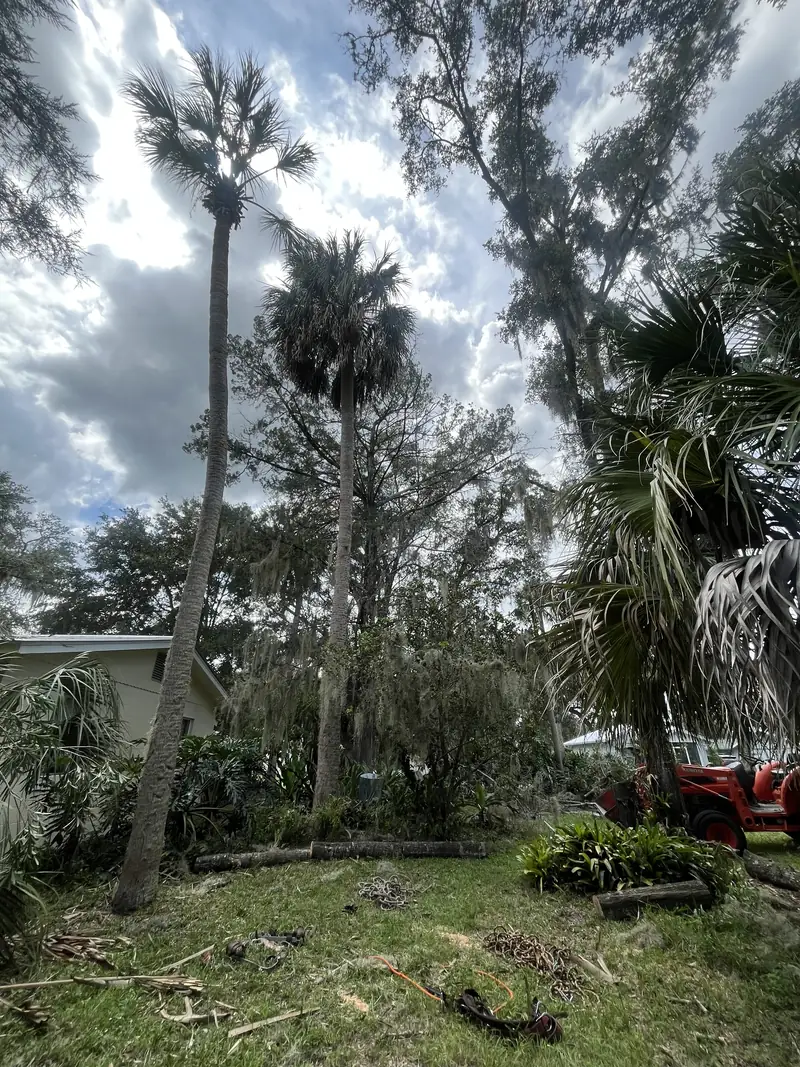
Three things shape most removals more than the height of the tree.
- Access. Tell us how a truck can reach the tree. A tree in an open side yard is a different job from one behind a fenced backyard, where the wood may have to come out in sections by hand.
- What is underneath it. Roofs, sheds, fences, a septic area or overhead wires all change how the tree is taken down. If a wire runs through the canopy, the utility needs to be involved before anyone climbs.
- The lot next door. If the tree leans over a neighboring lot, talk to that owner about access and where cut wood may land before the work date.
Decide about the stump at the same time. Some owners leave it, and others want stump grinding so the area can be reused. Ask whether the quote includes the stump, the surface roots and the grindings, and whether the wood is hauled away or left for you.
If a storm puts a tree on the house or across the driveway, that is emergency tree removal, and our phone is answered by a real person 24 hours a day.
Questions to ask before you book
- Is the tree four inches or more across at four and a half feet, and has the county confirmed what permit it needs?
- If you are relying on the hazard tree exception, do you have the signed assessment?
- How will the crew reach the tree, and what will they protect on the way in?
- Does the written quote cover the stump and hauling the wood?
See the full list of towns we serve on our service areas page. To have us look at the tree and put the scope in writing, request a quote.